

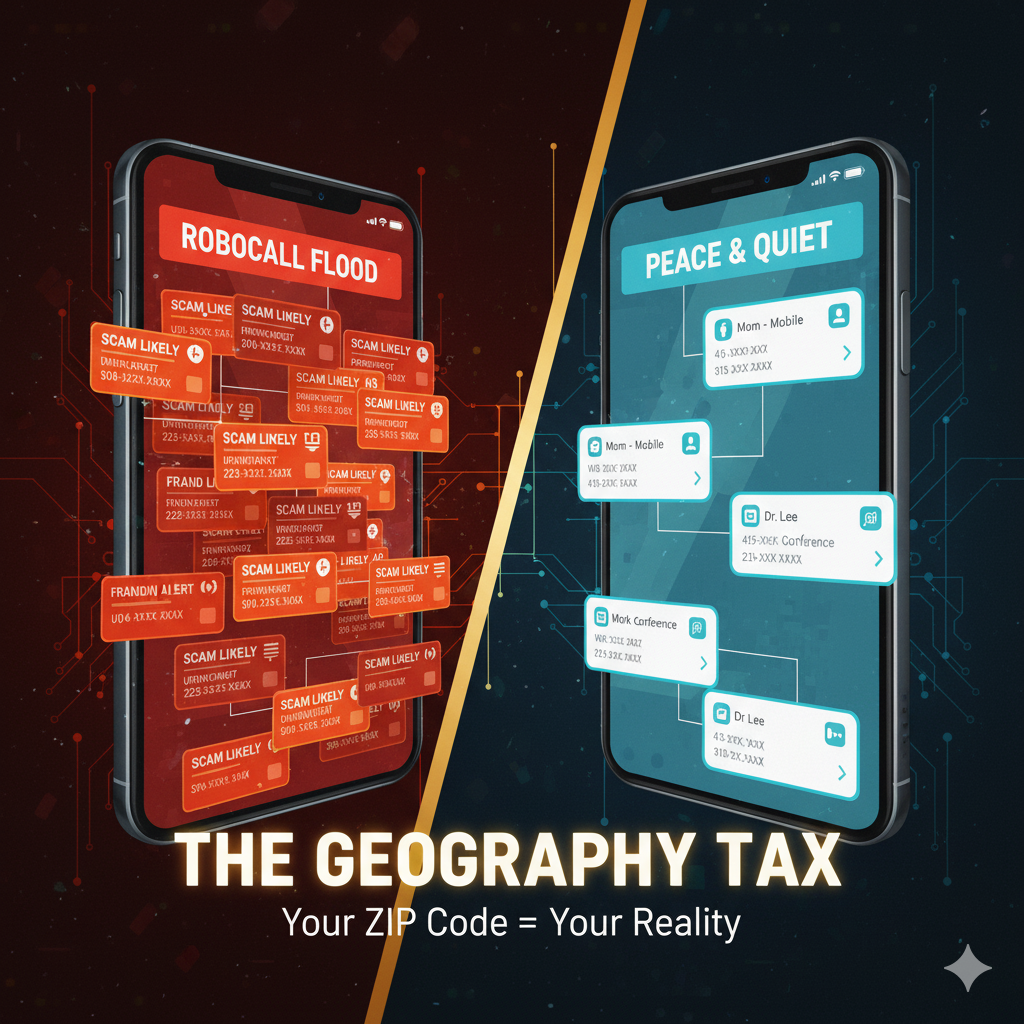
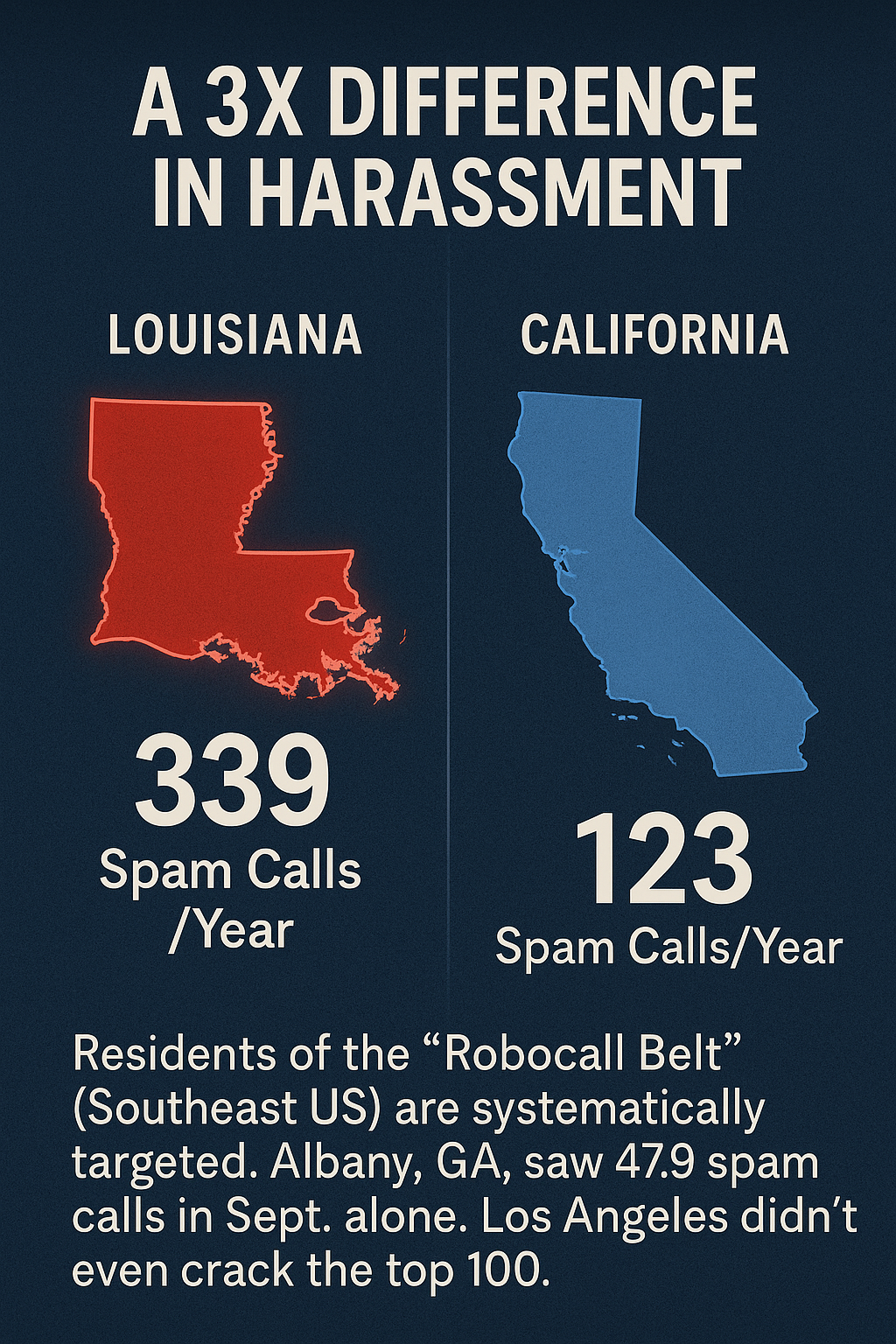
If you live in Louisiana, you might receive multiple spam calls ever single day. If you live in California, you might get one every other day. Same country. Same federal laws. Vastly different realities. This isn't random chance, it's a systematic "geography tax" where your area code determines whether you experience robocalls as an occasional nuisance or a daily crisis.
September 2025 data reveals the shocking truth: residents of Albany, Georgia endured 47.9 spam calls per person in just one month, while major California cities like Los Angeles, San Francisco, and Sacramento didn't even crack the top 100, all receiving fewer than 12.9 calls per capita. That's nearly 4x the harassment level based purely on where you live.
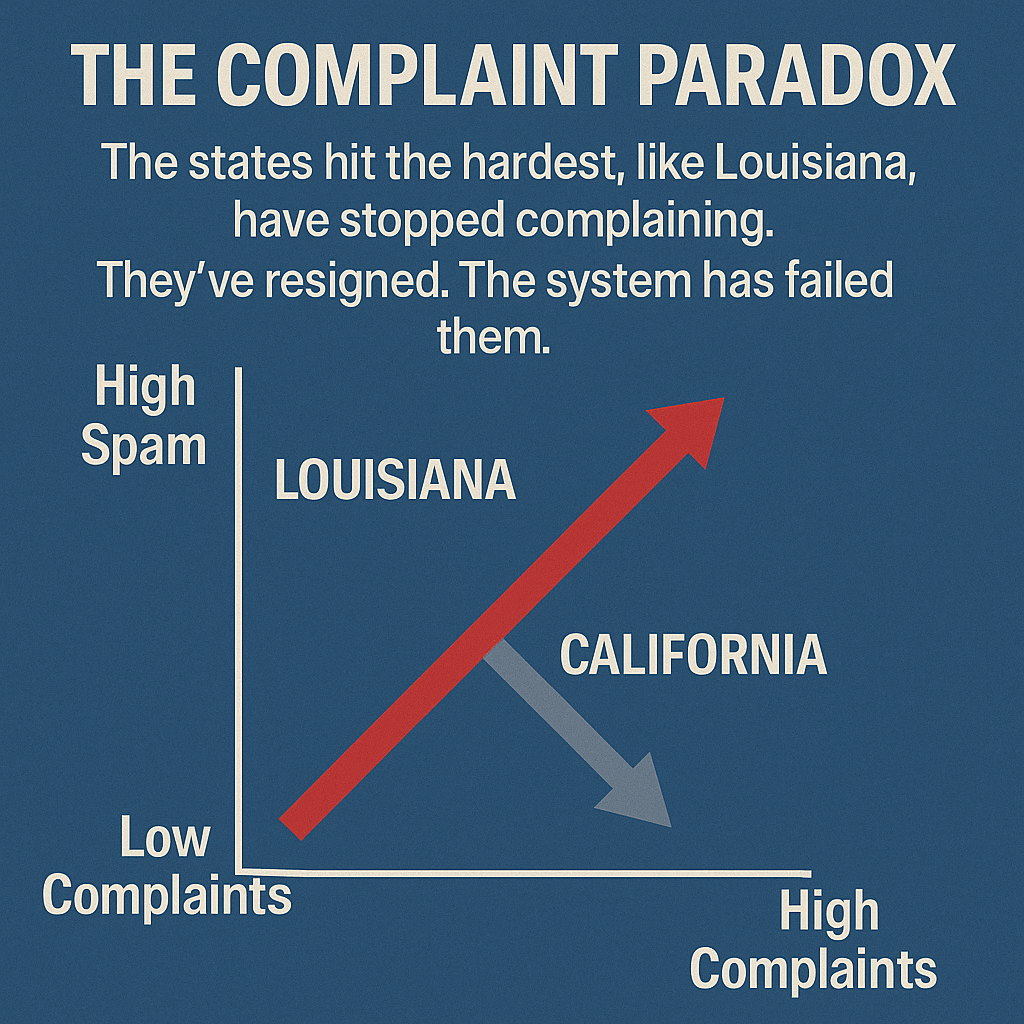
But here's the paradox that reveals how broken our system really is: the states getting hammered the hardest are the ones complaining the least. Louisiana leads the nation with 339 spam calls per person annually, yet ranks 44th in filing official complaints to the FTC. Meanwhile, California, with just 123 calls per person, ranks 9th in complaint activity. The geography tax doesn't just mean more calls; it means less hope that anything will change.
The Statistical Divide: A Tale of Two Americas
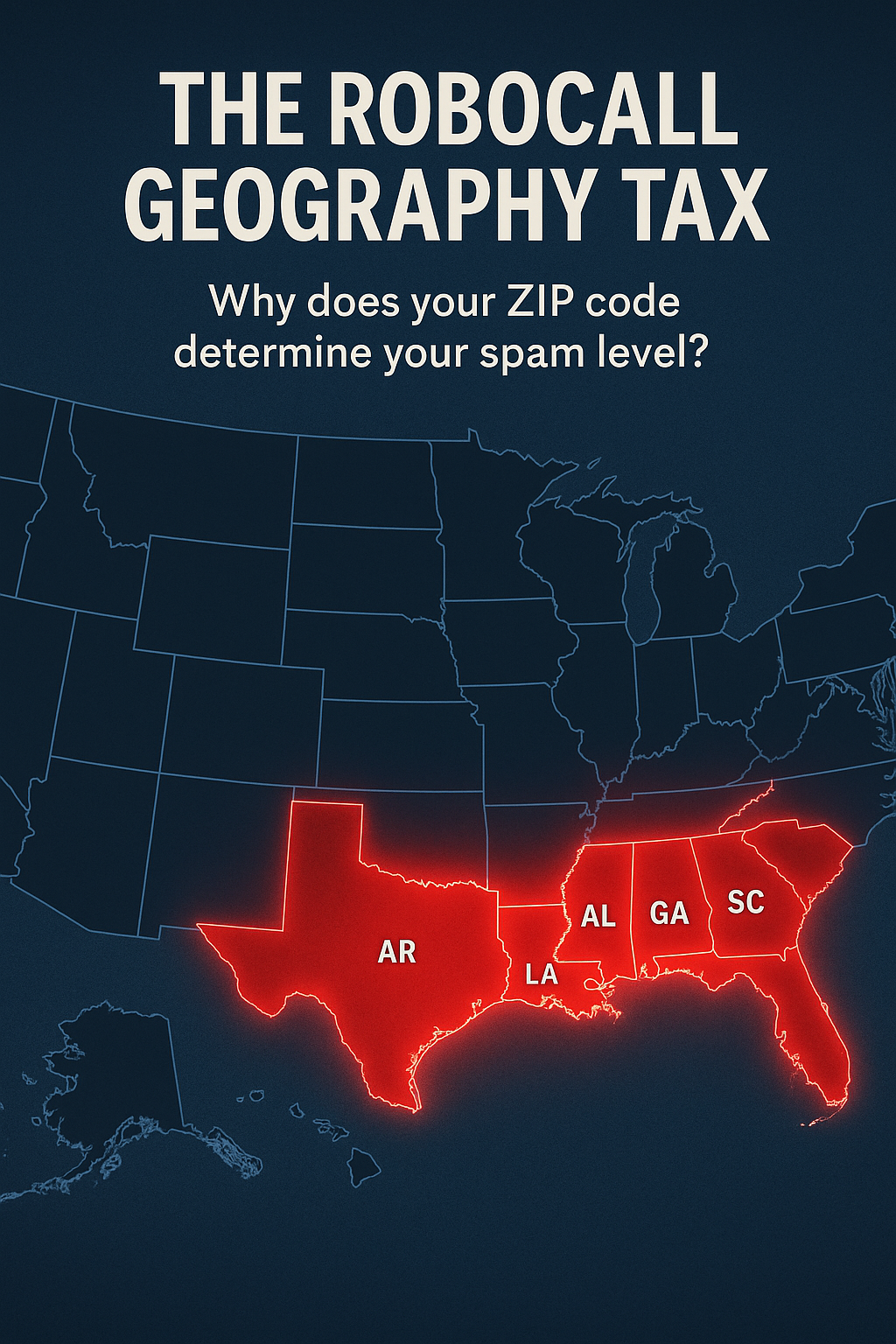
The numbers paint a disturbing picture of regional inequality in America's communication infrastructure. According to comprehensive 2023 data and September 2025 robocall tracking, the Southeast has become what experts call the "robocall belt", a concentrated zone of digital harassment that most of the country doesn't even realize exists.
Top 10 Cities by Spam Calls Per Capita (September 2025):
- Albany, GA - 47.9 calls per person
- Baton Rouge, LA - 39.2 calls per person
- Macon, GA - 36.4 calls per person
- Memphis, TN - 36.0 calls per person
- Little Rock, AR - 34.2 calls per person
- Savannah, GA - 31.3 calls per person
- Columbia, SC - 31.1 calls per person
- Shreveport, LA - 30.4 calls per person
- Charleston, SC - 29.5 calls per person
- Jackson, TN - 28.6 calls per person
Notice a pattern? Every single city is in the Southeast. Not one California, New York, or Massachusetts city makes the list.
The annual statistics are even more revealing. The top five states for spam calls per person are all Southeastern: Louisiana (339), Georgia (307), South Carolina (248), Alabama (248), and Arkansas (238). California ranks 27th with just 123 calls per person, less than half the rate of the most-targeted states.
The Complaint Paradox
Here's where it gets truly disturbing. FTC National Do Not Call Registry data for 2024 reveals an inverse relationship between spam call volume and complaint activity:
| State | Annual Calls Per Capita | FTC Complaint Rank | Complaints Per 100k |
|---|---|---|---|
| Louisiana | 339 | 44th | 449 |
| Mississippi | 209 | 41st | 469 |
| Alabama | 248 | 34th | 490 |
| Georgia | 307 | 20th | 618 |
| California | 123 | 9th | 730 |
The states suffering the most are reporting the least. This suggests something darker than simple annoyance: resignation. When you're drowning in spam calls, filing a complaint for one feels pointless when several more are expected the same day.
Why the Southeast Gets Hammered: Four Systematic Failures
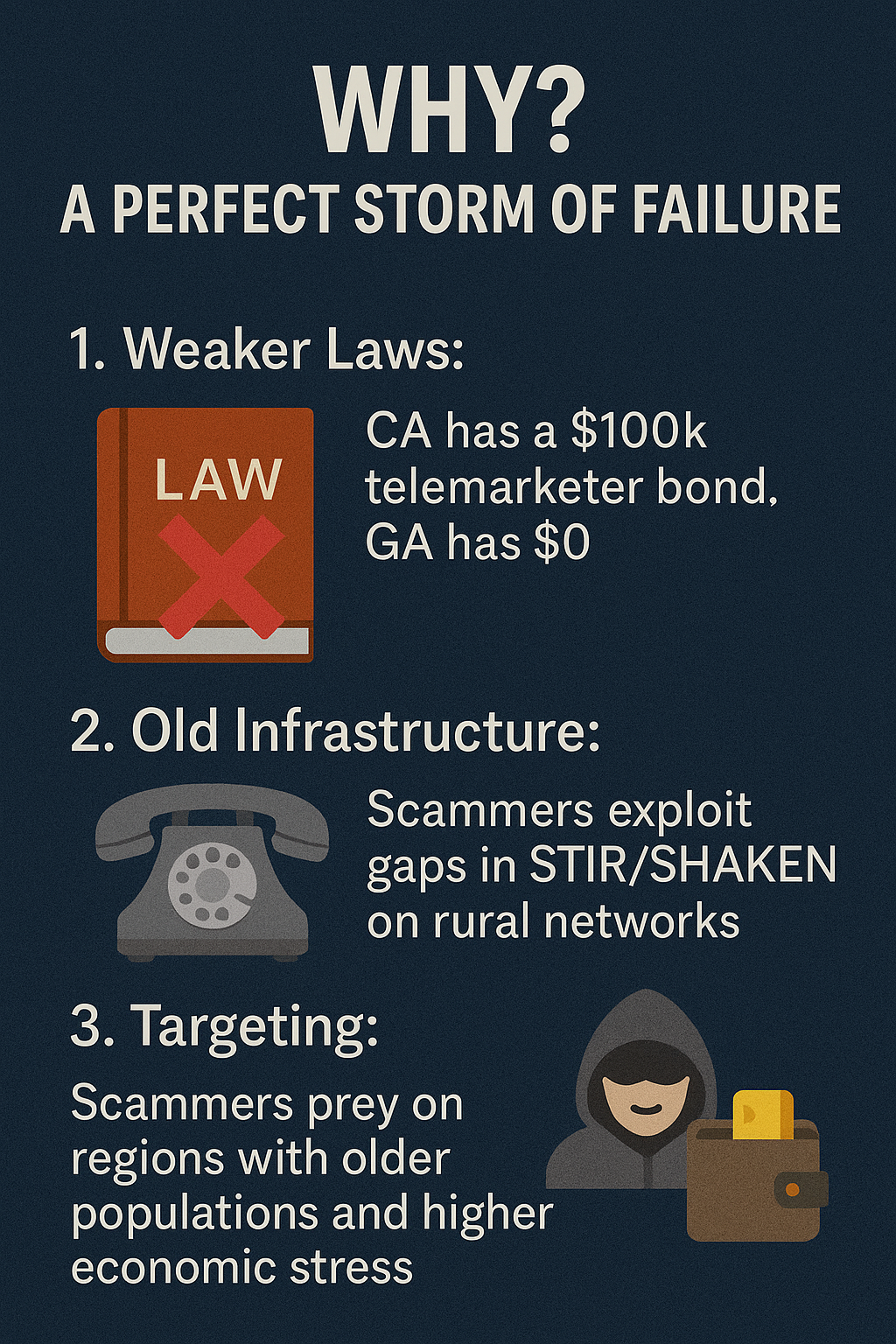
The geography tax isn't random. It's the result of four converging factors that make the Southeast a perfect storm for robocall exploitation.
1. The Regulatory Gap: $100,000 vs. Nothing
California mandates all telemarketers post a $100,000 surety bond before conducting business in the state, the highest or tied-for-highest requirement nationally. This creates massive financial exposure for bad actors. Violate California's Consumer Legal Remedies Act (CLRA) or Unfair Competition Law (UCL), and that bond gets seized. The state can also impose criminal penalties under its Penal Code for fraudulent robocalls.
Georgia and South Carolina? Zero telemarketer registration requirements. Alabama, Louisiana, and Arkansas require registration but with only $50,000 bonds, half California's deterrent. Without registration databases, these states can't conduct proactive compliance checks. They must wait reactively for complaints, creating a regulatory vacuum that scammers actively exploit.
The result: California Attorney General Rob Bonta issued multiple enforcement actions in 2024 alone, sending warning letters to 9 companies transmitting illegal robocalls and launching "Operation Robocall Roundup" with 51 attorneys general. This high-visibility enforcement creates public deterrent effects. Southeastern state attorneys general, while participating in multistate actions, generate far fewer individual initiatives, less enforcement means more scammers.
2. Infrastructure Vulnerabilities: The STIR/SHAKEN Gap
The Southeast's telecommunications infrastructure presents multiple technical vulnerabilities that California's more modern systems largely avoid. The STIR/SHAKEN caller ID authentication system, designed to stop number spoofing, shows a massive implementation gap between carriers.
A 2024 TNS report found that 86% of traffic between tier-1 carriers (AT&T, Verizon, T-Mobile) was properly authenticated. But smaller carriers? Only 17-21% of their calls carry valid STIR/SHAKEN signatures. This creates a massive security hole that bad actors actively exploit.
The Southeast hosts higher concentrations of independent rural carriers, regional operators that have operated since the mid-20th century but lack resources for advanced fraud detection systems. Legacy copper-based networks can't even support STIR/SHAKEN without expensive upgrades. Rural fiber installation costs in the Southeast run $5,800 per mile versus $2,200 in urban areas, making infrastructure modernization economically challenging.
Scammers know this. They route their calls through the weakest links in the chain, using least-cost routing to pass traffic through networks that haven't fully implemented authentication. When calls traverse legacy networks, digital signatures get stripped away, effectively "laundering" the call and making it nearly impossible to identify as illegitimate.
3. Demographic Targeting: Why Seniors Matter
Sarah McConomy, Chief Operating Officer of SellCell, provides the most direct explanation: "Southern states are more prone to spam calls and texts, which is likely because the median age is older in these states. Seniors are well evidenced to be mass targets for spammers."
The numbers back this up. Florida's median age is 42.6 years, South Carolina 40.5, Alabama 39.4, all higher than California's 38.3. FBI data shows 101,000+ victims aged 60+ reported elder fraud in 2023, with losses exceeding $3.4 billion and an average loss of $33,915 per victim.
Older populations face multiple vulnerabilities: cognitive decline increases scam susceptibility, they often possess retirement savings worth targeting, they can't recover losses through employment, and they maintain higher landline usage rates, 50.5% of Americans 65+ still have landlines compared to 71.7% national wireless-only rate. Landlines lack the smart blocking tools that smartphones have, creating an open door for scammers.
Beyond age, there's a cultural factor. The CEO of YouMail explicitly suggests that Atlanta's status as a robocall hotspot stems from "southern politeness", residents answer calls from unknown numbers at higher rates than other regions. From a scammer's perspective, this is critical: a higher answer rate means more opportunities to engage potential victims per thousand calls dialed.
4. Economic Desperation: The Debt Collection Connection
The income gap between California and southeastern states spans $30,000-50,000 per household annually, a chasm that fundamentally shapes vulnerability to financial scams. California's median household income of $95,521 stands 25% above the national median. Mississippi ranks lowest nationally at $43,529, Louisiana at $50,935, Alabama at $52,035.
This economic stress translates directly to bankruptcy rates: Alabama leads the nation with 297 bankruptcy filings per 100,000 residents, more than twice the national average. Tennessee records 610 per 100,000, Georgia 524-763 per 100,000. California, despite recording the most total filings due to its massive population, shows only 119 per 100,000 residents.
This creates a debt collection ecosystem that directly fuels spam call targeting. Florida experienced a 179% increase in debt collection complaints in Q1 2025 versus Q1 2024. The massive legitimate debt collection activity targeting financially stressed populations creates multiple problems: residents become conditioned to answering collection calls, making it harder to distinguish legitimate from scam calls; debtor lists circulate and eventually leak to scammer networks; and economic desperation makes residents more likely to engage with scam "debt reduction" offers out of fear.
Scammers specifically target areas with high debt collection activity, knowing lower-income populations have limited financial cushions and reduced access to robust consumer protections. The combination of crushing debt, aggressive collection activity, weak legal protections, and economic desperation creates populations that scammers deliberately seek out.
Why Californians Don't Feel the Crisis
If you live in Los Angeles or San Francisco, you might be thinking: "Are spam calls really that bad?" The data says you're experiencing a fundamentally different reality than your fellow Americans in the Southeast.
Tech-savvy population advantage: California's younger, tech-oriented demographic adopts call-blocking apps faster, uses built-in iPhone/Android spam filters more effectively, and simply doesn't answer unknown numbers. As consumer expert Clark Howard puts it: "If I don't recognize the number, I do not answer", a common ethos in California that's less prevalent in regions where answering local-looking calls is considered polite.
Population dilution effect: California's 40 million residents dilute spam call campaigns on a per capita basis. A robocaller blasting out 1 million calls spread across California's numerous area codes barely registers for each person. In Louisiana (4.6 million people) or South Carolina (5.3 million), a similar campaign means every resident's phone might ring.
Legal deterrent effect: California's robust private right of action under the TCPA, CLRA, and UCL means any single illegal call can trigger a lawsuit. Consumer law attorneys actively pursue these cases, often as class actions. The multi-layered threat, from individual consumers, class-action attorneys, state prosecutors, and federal regulators, creates a powerful disincentive for high-volume, indiscriminate robocall campaigns targeting the state.
Different scam profiles: Scammers tailor campaigns to where they'll get results. California's demographics skew younger, more diverse, and higher-income. Certain scams specifically prey on Southern touchpoints, fake Medicare calls disproportionately hit states with many retirees, "free vacation" timeshare robocalls target Sun Belt states, and auto warranty scams resonate in car-dependent regions.
Beyond Calls: The Multi-Channel Assault
Here's what makes this crisis even more insidious: when one channel gets blocked, scammers simply pivot to another.
Americans received more spam texts than calls in recent years, with a massive uptick in SMS-based "smishing" scams. States like California and Texas lead in spam text volume due to their huge populations, while Arizona and Nevada have seen sharp rises in fraudulent texts since 2023. When carriers crack down on robocalls, criminals migrate to inboxes and DMs.
Email spam remains massive: roughly 45% of all emails worldwide are spam, that's 160+ billion spam emails sent per day, pushing phishing links, fake invoices, and lottery scams into mailboxes. And social media platforms from Facebook Messenger to WhatsApp see scammers sending fake prize notifications or impersonating friends and family in distress.
The bottom line: no region is truly safe from unwanted contact. The Southeast might suffer most from calls, while elsewhere it might be SMS or email scams. The medium differs, but the menace is the same, and it's spreading.
First Orion's research documents how scammers shifted from simple "neighborhood spoofing" (matching local area codes) to sophisticated "enterprise spoofing" where they impersonate known businesses using stolen personal data. Their 2022 report found 75% of scam victims who lost money reported callers already possessed their personal information, home addresses, portions of Social Security numbers, or other identifying details.
This data-driven targeting means scammers don't call randomly. They acquire breach data showing residents of specific regions, cross-reference it with demographic information showing age and income characteristics, and systematically target those populations. The Southeast's combination of major breach exposures, older populations with savings, economically stressed residents vulnerable to debt-related scams, and lower digital literacy creates what scammers view as optimal target markets.
What This Means for You: The Awareness Gap
A Louisiana resident averaging 339 robocalls annually experiences a fundamentally different reality than a Massachusetts resident, yet most Americans don't realize this geographic disparity exists.
Research on health disparities and political polarization demonstrates that people dramatically misunderstand realities they don't personally experience, often by factors of 2-3x or more. A Californian receiving 8-10 robocalls monthly might view spam calls as a minor nuisance requiring no urgent policy response. A Georgian receiving 25-30 monthly calls experiences it as a crisis demanding immediate action.
National policy debates about robocall severity get shaped by which regions' voices dominate the conversation. When Silicon Valley's concentration in low-impact California influences tech industry priorities, robocall solutions take longer to implement, because tech industry leaders don't personally experience the crisis that southeastern residents face daily.
If you're in the Southeast: your experience is real, and the data proves it. You're not imagining that your phone rings more than your friends in other states. You're facing systematic targeting due to factors beyond your control, state regulatory gaps, outdated infrastructure, demographic characteristics scammers specifically seek, and economic stress that makes certain scams more effective.
If you're elsewhere: today it's the Southeast, tomorrow it could be you. Scammers adapt constantly, and historical spread patterns show how spam tactics evolve and migrate geographically. The $25.4 billion in national losses affects everyone through increased fraud prevention costs that companies pass to consumers.
Taking Back Control: Solutions That Work Everywhere
The geography tax reveals a fundamental truth: you can't rely on your state's laws or your carrier's infrastructure to protect you. When protection varies by ZIP code, you need solutions that work everywhere, across all channels, regardless of local regulations.
This is exactly why economic solutions like KarmaCall matter. While comprehensive systemic reform is essential, better state laws, universal STIR/SHAKEN implementation, cross-sector coordination, those changes take years. You need protection today.
KarmaCall's approach works because it addresses the root cause that makes all scams possible: zero-cost mass communication. By requiring unknown callers to put up tiny refundable deposits to reach you, the economics of mass scamming become impossible. Legitimate callers get refunded when you engage. Scammers with less than 1% response rates lose money on every campaign.
The technology extends beyond calls to texts, emails, and messaging apps, giving you one shield against all spam channels. As scammers migrate from calls to texts to Instagram DMs, your protection travels with them. It's a truly omnipresent defense that doesn't depend on whether your state has a $100,000 bond requirement or your carrier has implemented STIR/SHAKEN.
Most importantly: it works globally. Whether spam originates from a VoIP line in India or a spoofed number in Atlanta, KarmaCall's system treats it the same. This is crucial when over 90% of spam calls received by Americans appear to originate domestically (spoofed local numbers), but in reality many are orchestrated from overseas call centers.
The Path Forward: From Geography Tax to Digital Equality
The robocall geography tax isn't just about annoyance, it's about systematic exploitation of populations made vulnerable by policy failures and historical underinvestment. Residents of southeastern states face higher exposure due to factors beyond individual control, creating a digital inequality that mirrors and reinforces economic inequality.
The choice is clear: wait for comprehensive regulatory reform that could take years, or adopt economic solutions that protect you right now while systemic changes mature. Ideally, we need both, strong state laws AND economic barriers that make scamming unprofitable regardless of jurisdiction.
67% of Americans nationally report receiving more spam calls in 2024 than 2023, indicating the problem grows even as regional disparities persist. The challenge: making California policymakers and tech industry leaders, concentrated in a relatively low-impact region, understand the severity that southeastern residents face daily.
Until then, your area code will continue determining whether you experience robocalls as occasional nuisance or daily crisis, a geographic lottery no one should have to play.

Don't Let Your ZIP Code Determine Your Spam Reality
Protect yourself with a solution that works everywhere, across calls, texts, emails, and social media, regardless of your state's laws or your carrier's infrastructure.
The robocall geography tax reveals a broken system where your location determines your harassment level. While we fight for systemic reform, economic solutions offer protection today, turning the tables on scammers by making their business model unprofitable, regardless of which state you call home.
Data sources: YouMail Robocall Index (September 2025), FTC National Do Not Call Registry Data Book (FY 2024), WhistleOut Robocall Epidemic Study (2023), TNS Robocall Investigation Report (2024), Truecaller U.S. Spam Report (2025)


