

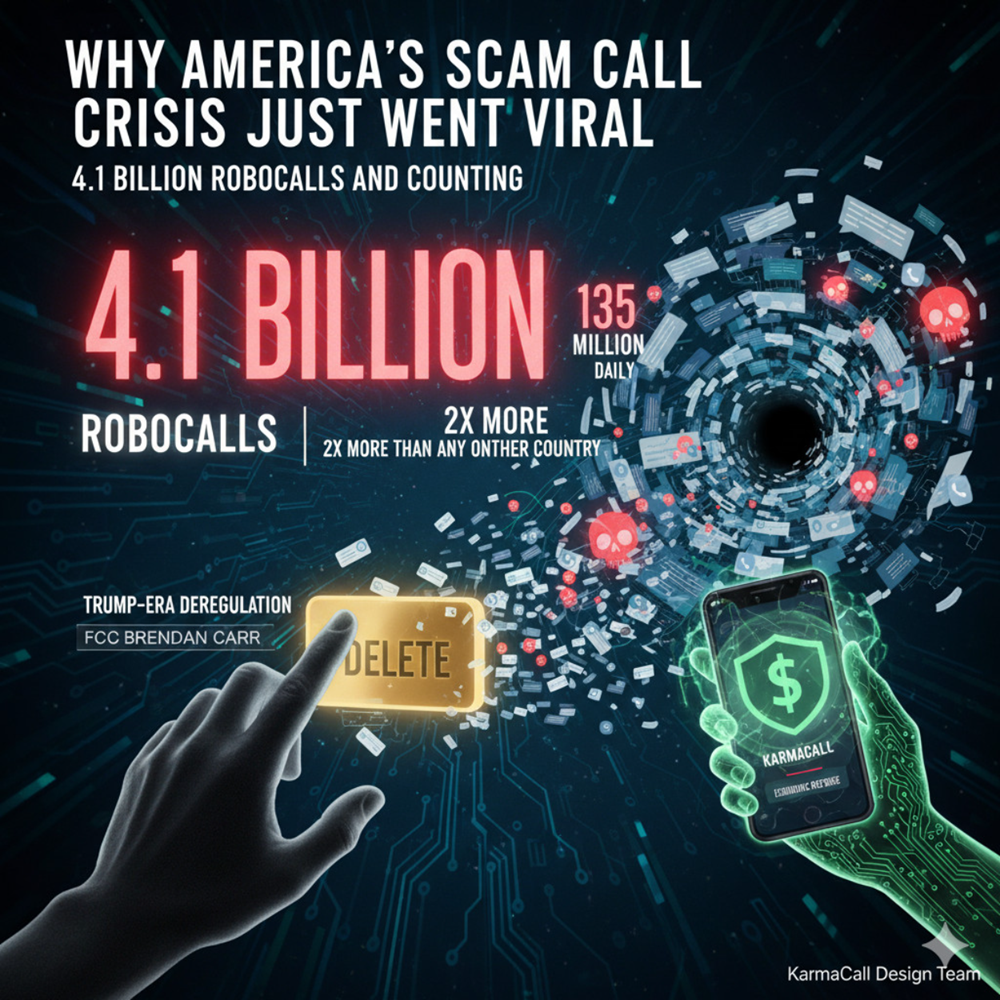
An article from Techdirt about America's scam call crisis went viral yesterday on Reddit's r/technology subreddit, and for good reason: it reveals a disturbing truth about how regulatory failure is making an already unbearable problem dramatically worse.
The headline says it all: "America Is Drowning In Scam Calls And Texts And Donald Trump Is Making It Worse". The article resonated with thousands of Americans who've simply stopped answering their phones, a reality that shouldn't be normal in any functioning democracy.
The Viral Statistics That Shocked Reddit
The numbers that drove this article to the top of r/technology are staggering:
America's robocall crisis by the numbers:
- 4.1 billion robocalls received by Americans so far this year
- 135 million robocalls every single day
- 2x more scam calls than any other country
- massive text message scam surge targeting 18-29 year olds
As Techdirt's Karl Bode points out: "Just so you know: it's not normal for your country's voice communications networks to be completely hijacked by scammers and marketers, rendering it almost unusable. That's literally not something people in most serious countries have to deal with."
Why Reddit Users Are So Angry: Deregulation at the Worst Time
The article struck a nerve because it reveals how the Trump administration's FCC, led by Brendan Carr, is actively dismantling consumer protections exactly when Americans need them most.
Brendan Carr's "delete, delete, delete" initiative:
The Trump FCC boss has been taking what Techdirt calls "an absolute hatchet to the FCC's consumer protection authority under the guise of improving government efficiency." This includes:
- eliminating rules that make it easier for consumers to opt out of unwanted texts and calls
- derailing cybersecurity reforms with no coherent reason
- reducing transparency and public input to historic lows
As one viral comment on the Reddit thread noted: "We've literally normalized the fact that Americans are so inundated with unwanted scams and bullshit that they don't answer the phone."
The Corporate Profit Motive Behind Your Scam Calls
Here's what many people don't realize: big wireless carriers profit from scam traffic.
From the Techdirt article:
"A sizeable chunk of our robocall is caused by big wireless carriers that turn a blind eye to scams and fraud because they get a cut and Trump is making it all but impossible to hold these companies accountable for anything."
This explains why the problem persists despite available technical solutions. When carriers make money from scam call volume, they have little incentive to stop it, especially when regulators are being systematically defanged.
Text Message Scams: The New Frontier
According to a new study from Consumer Reports, Aspen Digital, and the Global Cyber Alliance cited in the article, there's been a massive uptick in text messaging-based scams over the last year.
Yael Grauer, program manager at Consumer Reports, warns:
"Cyberattacks and digital scams continue to cause serious harm to American consumers, often with devastating consequences. Government and industry must do more to protect consumer privacy and security, but with federal consumer protection agencies facing reduced resources, it is even more critical to empower consumers to adopt strong cybersecurity practices against increasingly sophisticated scams and attacks."
The problem? consumer education alone can't defend against AI-powered scams at industrial scale, especially when government agencies tasked with enforcement are being hollowed out.
Why Other Countries Don't Have This Problem
The Talker Research survey of 10,500 adults reveals Americans get twice as many scam calls and texts as any other country, and even more than countries with functional consumer protection laws and effective regulators.
This isn't a technology problem. It's a governance and incentive problem.
Countries with:
- meaningful privacy laws
- empowered regulatory agencies
- carrier accountability requirements
...simply don't experience this level of communication infrastructure hijacking.
The Systemic Corruption Connection
Techdirt makes the critical point that many Americans are waking up to:
"Like so many systemic U.S. problems, the robocall and phone scam problem simply isn't something that gets fixed without first embracing much broader corruption, campaign finance, lobbying, and legal reforms."
The article characterizes the current situation as "the end result of an unholy alliance of authoritarianism and corporate power. A fake populist movement stocked with corrupt zealots, dead set on dismantling the country's last vestiges of consumer protection."
The Reddit comments reflected widespread agreement: thousands of users shared their frustration with a system that prioritizes corporate profits over the basic ability to use a phone without harassment.
It's About to Get Worse
The most chilling part of the article is this warning:
"So however bad you think scam and marketing texts and calls are now, they're extremely likely to get significantly worse."
With the FCC's consumer protection authority being systematically dismantled, and no political will to hold carriers accountable, there's no reason to expect improvement through traditional regulatory channels.
When Government Fails: Economic Solutions Step In
This is exactly the scenario where market-based economic solutions become essential.
When:
- regulators are captured by the industries they're meant to oversee
- consumer protection agencies are defunded or eliminated
- carriers profit from the problem rather than the solution
- corruption prevents legislative fixes
...then individuals need tools that work regardless of government action.
how KarmaCall addresses regulatory failure:
the economic defense that doesn't require fcc enforcement:
- scammers must deposit tiny amounts per call/text
- legitimate callers get refunded when you engage
- scam operations become unprofitable at scale
- you get paid for blocking the scams that slip through
- no government permission needed to protect yourself
the key insight: when regulators won't protect you, economic incentives can, by making the scammer business model unprofitable regardless of carrier cooperation.
why this matters when Brendan Carr is deleting protections:
Traditional consumer protection requires:
- functional regulatory agencies ❌ (being dismantled)
- carrier cooperation ❌ (they profit from scams)
- enforcement mechanisms ❌ (politically blocked)
- legislative action ❌ (corruption prevents it)
Economic protection requires:
- individual adoption ✅ (works immediately)
- network effects ✅ (improves with scale)
- market incentives ✅ (aligns interests)
- zero regulatory approval ✅ (deploy today)
Real-World Proof: 500,000+ Payments and Counting
This isn't theoretical. While the FCC dismantles protections, KarmaCall has already:
- made 500,000+ instant payments to users for blocking scam calls and texts
- proven the economic model that makes mass scamming unprofitable
- created scalable infrastructure that works without government support
- demonstrated that market solutions can fill regulatory voids
As one Reddit commenter put it: "I don't answer the phone anymore unless it's from someone in my contacts. It's the only way to stay sane."
with KarmaCall, you don't have to choose between sanity and missing important calls. legitimate callers can reach you by demonstrating economic commitment, while scammers are priced out entirely.
The Reddit Response: Why This Article Resonated
The Reddit thread on r/technology exploded because it articulated what millions of Americans are experiencing but mainstream media often ignores. regulatory capture is making your daily life measurably worse.
Top-voted comments included:
- users sharing their complete inability to trust phone calls anymore
- frustration with carriers who clearly profit from scam traffic
- anger at the "efficiency" excuse for dismantling consumer protection
- recognition that this is a uniquely American problem caused by corruption
The Broader Pattern: When Deregulation Means "Freedom to Scam You"
The article connects the robocall crisis to a broader pattern:
"Trump FCC boss Brendan Carr has been taking an absolute hatchet to the FCC's consumer protection authority under the guise of improving government efficiency."
This is the same playbook used across industries:
- claim regulation is "inefficient"
- dismantle consumer protections
- let corporations extract maximum profit
- leave consumers defenseless
- blame individuals for not "protecting themselves"
the robocall crisis is just the most visceral example because you can't ignore a phone ringing 10 times a day with scams.
What You Can Do When Government Won't
The Techdirt article ends on a sobering note: "That is, obviously and indisputably, not something that's happening under Trump and his sycophantic regulators and telecom industry-coddling courts."
but individual action can still make a difference:
for yourself:
- deploy economic protection that works today
- stop relying on government agencies that have been captured
- use tools that align incentives rather than fight them
for your community:
- share articles like this that expose regulatory failure
- support economic solutions that don't require political approval
- demand accountability from carriers who profit from scams
for long-term change:
- recognize this as a corruption problem, not just a technology problem
- support campaign finance and lobbying reforms
- vote for representatives who won't gut consumer protection
The Choice: Wait for Government or Protect Yourself Now
As the article makes clear, waiting for the FCC to fix this problem is futile when the FCC is actively making it worse.
you have two options:
option 1: hope regulators reverse course
- requires political change
- needs years of legislative action
- assumes corruption can be overcome
- leaves you vulnerable meanwhile
option 2: adopt economic protection today
- works immediately upon installation
- requires no political change
- circumvents corrupt incentives
- protects you while fighting for systemic reform
Conclusion: Why This Went Viral And What It Means
The Techdirt article resonated because it named what Americans are living through. the deliberate destruction of consumer protection in service of corporate profits.
4.1 billion robocalls this year. 135 million every day. Twice as many as any other country.
this isn't an accident. it's policy.
And when policy fails this badly, when regulatory agencies become weapons against the people they're meant to protect, economic solutions become not just useful, but essential.
The thousands of Reddit users who upvoted and commented on this article understand something profound: you can't shame your way out of a problem caused by perverse incentives. You have to change the incentives themselves.
Don't wait for Brendan Carr to protect you
while the fcc dismantles consumer protection, economic solutions work today without requiring government permission.
when government fails, markets can still work if we build systems that align economic incentives with consumer protection. the robocall crisis proves we need both regulatory reform AND individual tools that don't depend on regulatory enforcement.
sources: Techdirt, Reddit r/technology, Talker Research survey (10,500 adults), Consumer Reports/Aspen Digital/Global Cyber Alliance study


